9 min read
Everything you need to know about Power BI

Power BI is one of the most popular Business Intelligence tools around today. The software has a large fan base, and it's no surprise that Gartner repeatedly names it a Leader in their Magic Quadrant report. But if you're not familiar with Power BI, all of this probably doesn't mean much to you yet. In this blog we'll explain what Power BI is and everything you can do with it.
What is Power BI?
Microsoft Power BI is actually an umbrella term for a range of cloud-based apps and services that let your organization easily organize, manage, and analyze your data.
Essentially, Power BI collects and processes your data and turns it into data visualizations that let you generate insights. Power BI is therefore a true Business Intelligence tool. With the tool you can connect to various internal and external, online or offline, data sources. For example ERP and CRM systems, Excel, Google Analytics, and Facebook.
Why use Power BI?
The search for the right Business Intelligence tool often starts because you're currently experiencing problems with your current way of working. For example, your organization might currently do everything in Excel, which means the data isn't up to date and it's often difficult to keep an overview of all those different documents. On top of that, working in Excel is a manual and time-consuming process. In that case, Power BI could be the solution.
With Power BI you automate that entire process. There's only one place where your data lives, and therefore only one version of the truth. You no longer have to deal with a flood of Excel documents and can find all your information in one place. This lets you focus more on generating insights. Want to know more about why Power BI is a better BI tool than Excel? Then read our blog '7 reasons why Power BI is a better BI tool than Excel'.
Power BI is also one of the fastest-growing BI platforms currently available. Microsoft rolls out monthly updates, so improvements are continuously being added to the tool. In addition, Power BI has been a market leader in the Gartner Magic Quadrant for Analytics and Business Intelligence Platforms for 14 years.
What can I do with Power BI?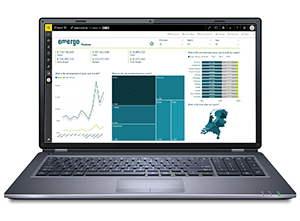
Power BI offers a wide range of possibilities when it comes to Business Intelligence. For example, the tool makes it easy to create reports and generate insights based on your data. Power BI also lets you connect numerous data sources and 'clean' them so that the information that's unlocked can be processed and understood better.
Power BI also helps you not only see what happened in the past and present, but also make estimates about the future. The tool is equipped with numerous Machine Learning capabilities, which means it can recognize patterns in your data and use those patterns to make predictions about the future. This also allows the tool to run "what if" scenarios. With these estimates you can generate forecasts and prepare yourself to meet future demands and other important statistics.
Of course, you can do a lot more with Power BI, such as integrating the tool in various ways with your other Microsoft 365 products, like Microsoft Teams. Within Microsoft Teams, it's possible to use and display Power BI reports during, for example, a meeting. You can read more about this in our blog '6 ways to use Power BI in Teams (including how-to's!)'.
You can also use Power BI in combination with Power Automate. Both Power BI and Power Automate are part of the Power Platform, which brings several attractive benefits. It's possible to use Power Automate to fully automate certain processes and functions in Power BI. You can read more about this in our blog 'Power BI & Power Automate'.
How do I use Power BI?
When you get started with Power BI, there are a number of ways you can approach it. First of all, Power BI is generally a cloud-based tool. This means your data and your reports will live entirely online. That said, this doesn't mean it's not possible to work with Power BI on-premises. Power BI has a separate service for this: Power BI Report Server. This service is available if you have a paid Power BI subscription: Power BI Premium. You'll read more about the license types later in this blog.
You also need to decide whether you'll get started with Power BI yourself or choose to collaborate with, for example, a third party. Power BI is an extremely user-friendly tool that is of course free to begin with. You only need to start paying once you want to use more functionality.
The advantages of collaborating with a third party are that you can make use of specialist knowledge and that your concerns are literally taken off your hands. Together you'll look at what needs your organization has and how to fulfill them with Power BI. It's of course also possible to set up a collaboration with a third party where help is only provided occasionally. You can read more about this on our consultancy page.
Components of Power BI
Power BI consists of various programs and elements that all work together. Below are the three basic components:
- A Windows desktop program called Power BI Desktop (read more in this blog about how to get started with Power BI Desktop). Power BI Desktop is a free application you can install on your computer.
- An online SaaS (Software as a Service) program called Power BI service. This application is used entirely online via the browser. Power BI service is often used to share reports and dashboards.
- Mobile Power BI apps for Windows, iOS, and Android devices.
In addition to the three above, Power BI also has Power BI Report Builder for creating paginated reports that you want to share in Power BI service, and Power BI Report Server. This is an on-premises report server where you can publish your Power BI reports after creating them in Power BI Desktop.
Power BI versions and licenses
As you may have briefly read above, Power BI has various versions and licenses. Below we briefly explain what these are and what they do. If you want to know more about the different Power BI license types, you can read our blog 'How do Power BI licenses work'.
Power BI Desktop
Besides being Power BI's desktop program, Power BI Desktop is also Power BI's free license. With this free license you can already do quite a lot, but it has 1 major drawback: you can't share your reports and dashboards with other users.
Power BI Pro
Power BI Pro is the first paid version of Power BI. With a Power BI Pro license you pay per user. This license gives you the same basic functions as the Power BI Desktop license, with 1 major difference: with the Power BI Pro license you can share your reports and dashboards with other users.
Power BI Premium
The most extensive license type currently available is Power BI Premium. Since April 2021, the Power BI Premium license has been split into two licenses: Power BI Premium Per User (PPU) and Power BI Premium Capacity. The big difference between the two is that Power BI Premium Per User can be purchased on a per-user basis, while the Power BI Premium Capacity license is purchased based on capacity. Read more about this in our blog 'New: Power BI Premium Per User'.
Power BI Report Server
Power BI Report Server is a feature you get with a Power BI Premium Capacity license. It makes it possible to keep all your data on an on-premises environment. Your data thus stays local and doesn't go to the Cloud.
Power BI Embedded
Power BI Embedded is a Microsoft Azure service that lets you quickly embed data visualizations, reports, and dashboards in an app. With this license you can share your dashboards and reports with users who only have a free license.
The Power Platform
Power BI is part of the Power Platform, which is also an umbrella term for a number of tools that together make it easier to automate business processes. The Power Platform consists of the following components: Power BI, Power Apps, Power Automate, and Power Virtual Agents. You can read more about these components in this blog.
How do I get started with Power BI?
Are you excited about Power BI after reading this blog and want to get started yourself? Every month at E-mergo we offer a free Power BI Basics training. During this online training you'll discover how Power BI works and how to make the best use of it. After the training you'll know the basic principles of Power BI and can start using the tool. You can sign up via the button below.
Still want to know a bit more about Power BI before you get started? We've written a blog about the 8 things you should know before starting with Power BI. You can check out the blog via the button below.
The Golden Triangle
Although Power BI also offers the ability to collect and manage your data, using a Cloud Platform such as Azure and a Data Management Platform such as TimeXtender is a lot more convenient and faster when it comes to, for example, larger datasets. At E-mergo we're convinced that when you use Power BI as a Business Intelligence tool, there's an ideal combination to be made between BI, Cloud, and Data Warehouse tools. This combination consists of Microsoft Power BI, Microsoft Azure, and TimeXtender, and we call it the 'golden triangle'. Check out the blog about the Golden Triangle via the button below.